Meteora
Cartes Postales from GreeceMeteora is a region of immense natural rock pillars crowned by monasteries, a landscape in which physical remoteness becomes both a religious ideal and a human burden. The book first presents it as a place glimpsed from afar and sought out by a traveler, then as the setting for a story of brothers divided by monastic life. Its towering beauty promises distance from the ordinary world, but the lives connected to it make clear that isolation can bring peace, guilt, or tragedy.
Landscape and geological scale
The narrator first encounters Meteora through an old poster in a village taverna: a monastery perched on a pillar of natural rock, apparently inaccessible from the ground. The image gives only a hint of the landscape. When the narrator later arrives, the monasteries seem suspended above the surrounding world, on pinnacles described as rising hundreds of metres into the air. The name Meteora, meaning suspended in the air, captures the visual impression of buildings separated from ordinary human scale.
The account gives the scenery a history far older than its religious buildings. Around twenty-five million years ago, water stood at the height where the monasteries now sit; a gap opened through the rock, allowing the water to flow toward the Aegean. Wind and rain subsequently shaped the pillars into the dramatic landscape the narrator experiences as both mystical and sublime. This deep geological time makes the monasteries seem not simply built in a remote place, but set within a landscape formed by forces that dwarf human plans.
Monasteries and religious withdrawal
The monasteries are presented as the outcome of successive acts of retreat and construction. More than a thousand years ago, ascetics climbed into caves eroded in the rocks, seeking separation from worldly and bodily pleasures and a state of closeness to God. Centuries later, monks undertook the extraordinary task of lifting building materials onto the pinnacles and establishing twenty-four monasteries. Six remain, inhabited by small monastic communities whose isolation is heightened by the painted images of saints around them.
The narrator climbs a very steep path to visit the highest monastery, Great Meteoron Monastery, and wonders whether such separation still gives the monks peace of mind. The question is not answered by the grandeur of the architecture. Instead, a conversation in nearby Kalambaka complicates the romantic image of withdrawal. While waiting with a priest in a long queue at a cash machine, the narrator hears about continuing restrictions on bank withdrawals and the priest’s modest means. Asked about life in the monasteries, the priest explains that solitude and separation do not suit everyone. The ordinary queue, the cash-machine restrictions, and the monastery visible above the town bring economic hardship and religious seclusion into the same frame.
Family separation and the mountain story
Meteora is also where Dimitris, one of two brothers with sharply different lives, is sent after choosing the priesthood. His family had treated the boys’ contrasting interests as habits they might eventually outgrow: one prayed and kept a Bible beside his bed, while the other hid acne and dirty magazines beneath his mattress. Their father threatened to beat them if they did not change. In time, Giannis stopped getting spots, while Dimitris continued toward religious life and was sent far from home, to the monasteries above the shadowed houses that never saw the sun.
Giannis makes the long journey to visit Dimitris once a year. The visit offers him contact with what he experiences as the sublime, but his excitement is also tied to driving fast along the nearly empty road. Over the years his cars become increasingly flashy, from a Nissan to a BMW and then a red Porsche. Dimitris never sees the car: Giannis has to park some distance away. The detail quietly sets the brothers’ worlds against one another. Giannis arrives in visible displays of speed and consumption; Dimitris remains in a place organized around withdrawal from worldly life.
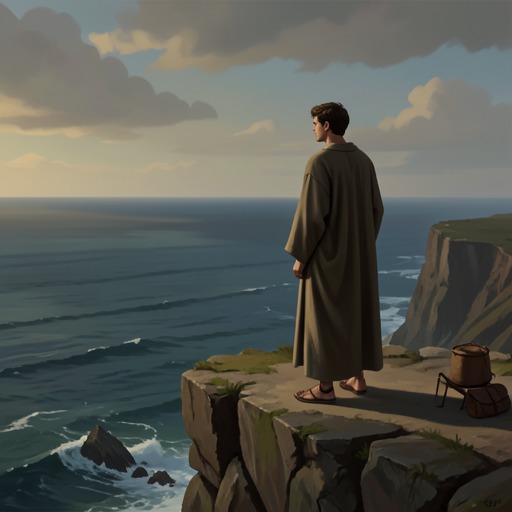
On one journey, Giannis glimpses an unlit, lonely monastery and then a solitary figure on a neighboring mountaintop. Mist swirls around the figure; clouds gather and break apart, and after the fog briefly hides him, the mountain is empty. Giannis turns up the radio and drives on. The moment leaves the disappearance unexplained in the scene, but the narrator’s subsequent reflection connects the mountain’s isolation with misplaced guilt and the tragic consequences that can attend a priest’s vow of celibacy. The remote landscape is therefore not merely a dramatic backdrop: it gives visible form to a life separated from family and ordinary companionship.
Travel, solitude, and the limits of the postcard
The narrator’s approach to Meteora belongs to a broader journey shaped by images of Greece. A corkboard of postcards and a growing desire to see the country for herself lead Ellie to question whether postcard skies exaggerate reality. The narrator, too, begins with an image: the poster above the taverna table. Meteora exceeds that image, but the encounter does not turn the place into uncomplicated spectacle. Its landscape is beautiful enough to feel otherworldly, while its monasteries and inhabitants prompt questions about what withdrawal costs.
After time in Kalambaka, the narrator reflects on the difference between loneliness and solitude. Greek usage, the account observes, does not neatly distinguish the two, and people may pity someone who is alone. Yet the narrator has grown stronger in solitude and recognizes that being alone need not mean being lonely. This personal recognition sits beside the priest’s warning that monastic separation does not suit everyone and the story of Dimitris, whose remote life is associated with guilt and a disappearance. Meteora thus holds two meanings in tension: it can offer a chosen distance through which a traveler finds quiet and self-understanding, but distance imposed or endured can become a source of profound human cost.